
Exclusive Interview With Alberto Nacci


Born in 1957 at Trapani (Italy), lives and works in Bergamo since 1982. Former professor of Sound Design at Academies of Fine Arts in Bergamo and Brescia, after a long career
musician with numerous musical productions and a rich concert activity, he dedicated
himself to the production of art and culture documentaries, industrial films and video art works received numerous international awards. His works are appreciated in Italy and abroad and selected some of the most important festivals of film and video art in Europe, USA, Asia. He participated, representing Italy, to EURONIGHT08, an international video art proposed by the Italian Institute of Culture in Toronto.
_________________________________________________________________________________________

On September 27, a major contemporary art exhibition at the Italian American Museum in San Francisco, California, called FRAMES, will feature 21 canvases printed with the frames from your amazing 21 music videos, about the “Body & Sound” series., that is huge! How the idea come about? And what experience awaits people?
I have been a jazz musician for over 30 years (tenor and alto sax, from 1978 to 2009 with numerous record productions and important international collaborations) and in 2014 while attending a jazz concert with a sax-voice DUO I thought about how important it is to "tell the music" through the gestures with which musicians express the relationship with their musical instruments. So I asked these musicians (Gabriella Mazza, vocals and Marco Gamba, double bass) to come to the studio to shoot a music video in which I would explore the importance of musicians' gestures in creating sounds. Thus was born the concept of this project which I called BODY&SOUND and made 21 musical films from 2014 to 2024 with important Italian and foreign musicians in the field of jazz, classical music and contemporary music: a journey into the heart of music which gave me a lot of satisfaction with numerous international awards in the most important film festivals around the world. In the FRAMES exhibition at the Italian American Museum in San Francisco, large format prints (160 x 90 cm) of frames taken from these films will be presented. The audience will have the opportunity to experience music in a new way through black and white images, frames of music videos in which each scene is created thinking that it can be stopped in time and become a work of art!

What are your expectations for the exhibition? And how do you feel about that after the results obtained during these years?
The exhibition in San Francisco is the second step of the FRAMES project which has already been proposed in 2023 in the halls of the prestigious ADI Design Museum in Milan. The objective was to create a new "bridge" between Italy and the USA thanks to this film project that speaks the language of music, a universal language understood by everyone without distinction of language, culture and traditions The FRAMES exhibition was born to travel the world and I will continue to make musical films involving musicians from different musical cultures.
How has your team's synergy influenced among all your projects?
My team comes from the music world. In each of my films the sound quality must be perfect and for this I collaborate with Dario Ravelli, an excellent sound engineer. The choice of musicians with whom I share every step of the creation of each work is also very important, also choosing together the musical pieces that make up the soundtrack. From an image point of view, the pre-production phase is very important, in which each shot is defined as if it were a pictorial work! I love Caravaggio and the relationship between the subject and the light that imbues him: each scene is built with a long preparation to create the light conditions that allow me to obtain "paintings" that can subsequently be printed and be part of the FRAMES exhibition. To do this it is very important to have a good feeling with the crew on set and this is only possible with great concentration and sharing of objectives.

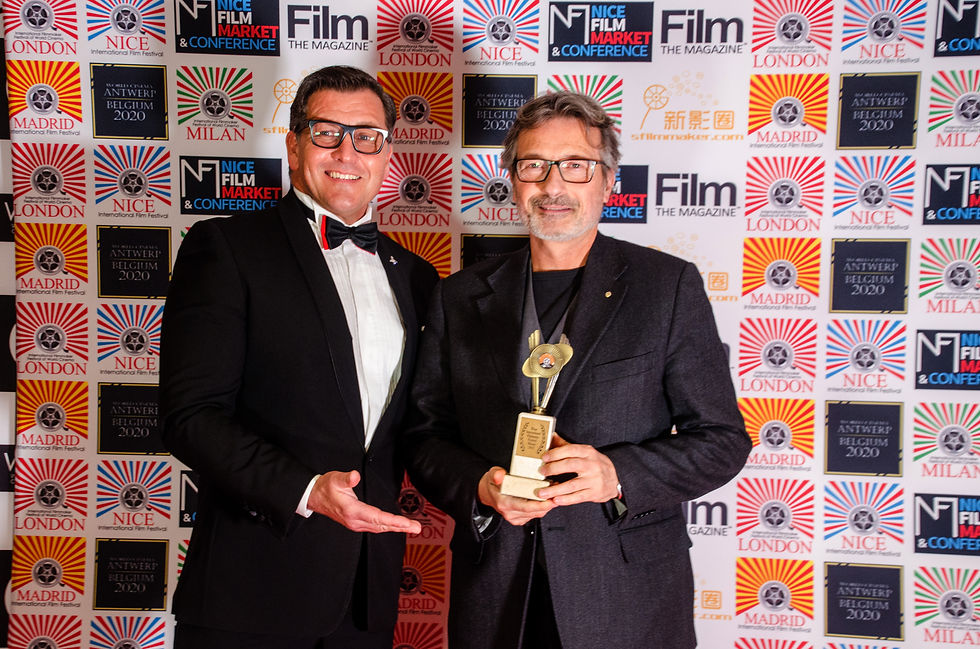
In order to undertand the value of your pieces, we would like to know more about the mind behind the process. How would you define your personal experience with cinema as a director? Could you tell us an experience or moment that change or challenge you?
My background as a musician greatly influences my activity as a director. Music is the breath of my images and even in my art and culture docufilms I consider "rhythm" very important as the driving element of my films. For this reason, silence is very important to me as it often allows me to create a "tension" to resolve particular moments in my films. In music we can define rhythm as an alternation of sounds and silences; the balance between these two dimensions is what I look for in all of my films. I remember the docufilm made with the artist Trento Longaretti (titled "Il Concerto") shot when the artist was 98 years old: each of his words had the "weight" of a pictorial paintingMy background as a musician greatly influences my activity as a director. Music is the breath of my images and even in my art and culture docufilms I consider "rhythm" very important as the driving element of my films. For this reason, silence is very important to me as it often allows me to create a "tension" to resolve particular moments in my films. In music we can define rhythm as an alternation of sounds and silences; the balance between these two dimensions is what I look for in all of my films. I remember the docufilm made with the artist Trento Longaretti (titled "Il Concerto") shot when the artist was 98 years old: each of his words had the "weight" of a pictorial painting and I wrote 4 different screenplays to find the "right" balance between the sequences of images, the artist's voice, his silences and the music of the soundtrack.
Can you tell us any difficulties you had during the filming?
During the filming of the docufilm "Luis de Pablo - The Song of Our Time" I had to face a situation that I had not foreseen in pre-production. I had to shoot with 4 cameras in the Sermoneta Castle during a concert by the Syntax Ensemble (directed by Pasquale Corrado) which interpreted a sequence of compositions by Luis de Pablo, the great Spanish composer of contemporary music. The Sermoneta Castle did not allow me to position the cameras where I wanted or create "lighting plans" that should have emphasized the scenes of my film. I then chose to position my smartphone near the piano keyboard (to have a backlight on the pianist's hands): a choice that presented many unknowns because I wouldn't have been able to shoot those scenes again but... it was a good choice that allowed me to have an interesting and effective shot. Only during the editing phase of the film was I able to evaluate the validity of that choice: looking at the piano keyboard as if the pianist's hands had eyes!

We'd like to learn more about the how and why you of your choice and vision for each project. If you had to name three key concepts to help everyone understand your work, what would they be?
My activity as director and producer takes place along two guidelines:
1) docufilms of art and culture;
2) docufiction on social themes.
These 2 areas of activity involve different reflections but have meeting points on the anthropological aspects of my way of making cinema.
What I'm interested in telling is above all the emotion experienced by every person I have in front of my camera, involved in a "story to tell" that always has to do with art and culture or talks about a social theme. They are almost always not professional actors and for this reason it is very important to create the right empathy between those behind the camera and those in front of it. Each scene can be unique, non-repeatable, and therefore even more precious. For this reason I consider it very important to share all my choices with the actors so that they too feel the responsibility of the director and can make a contribution to the quality of each scene that is shot on set. If the actor is a musician it is important to create an environment around him that favors his concentration in musical interpretation. If the actors are people who talk, for example, about a particular moment in their life, it is important that they "feel" that behind the camera there are people who pay attention to every detail, every look, every word, every silence, every gesture... which becomes precious for building a relationship of trust in which the actor feels "welcomed", "loved", "respected" especially in the most difficult situations.,My way of working is almost psychoanalytic and the actors who are in front of my camera appreciate this approach and often a beautiful relationship is born that becomes a friendship...,As happened with the documentary film IL TULIPANO VIOLA (The Purple Tulip) in which we involved 4 people with Parkinson's disease who talked about their coexistence with this terrible degenerative disease. Each film has a separate story which always arises from the desire to "look into the eyes" of the themes I address through the gaze of people who have "a story to tell".

Fellini once said that "all art is autobiographical", what was the most valuable thing you learned in your career? And what would you recommend to those who are taking their first steps in the cinema industry?
The most important thing I have learned in my career is to "only do what I believe in completely". Every film project involves a large investment of energy and time (even money!) and it is necessary to look ahead without losing sight of the objectives, especially of an artistic nature. Not working in the field of "commercial cinema", I believe that only high quality (expressive and technical) can allow us to achieve important objectives. Seeing that my films have been awarded in over 100 international film festivals is a great satisfaction for me and confirms that the choices made so far are right.,I would suggest to a young person who wants to work in the film industry to follow the same direction without ever forgetting himself!
Your music videos have achieved the incredible feat of winning 108 international film festivals around the world! Could you tell us more about your perspective on this? What's it like creating such high-quality, competitive projects, and how do you maintain that level of success over time?
To maintain high quality over time it is necessary to carefully choose each project to be carried out and above all to have partners who do not give up on quality: work without haste, wait for the "right moment" to arrive to carry out a new project... constantly looking at what is happening around you, knowing that today the comparison is global, that AI is an alternative for carrying out works in a short time but... human creativity MUST go beyond any algorithm. I use the AI of the DaVinci Resolve software (very stimulating!), I have deleted the word "impossible" from my vocabulary and I continue to think that Leonardo da Vinci is proof that everything we can think of can become reality!,What doesn't yet exist today is an excellent stimulus to move forward, the challenge with technology is certainly stimulating but... without ever giving up the emotion that accompanies every moment of our lives!

Can you tell us something about your next projects?
The FRAMES exhibition at the Italian American Museum in San Francisco CA will allow me to come into contact with American realities with the possibility of carrying out projects in the field of research into new dialogues between image and music. The FRAMES project was defined by the director of the ADI Design Museum in Milan as "a new frontier of Design in which the matrix is made of light". A new project could be the industrialization of the frames taken from my musical films from the Body&Sound Series, printed on canvas in 16:9 format on increasingly larger sheets, recalling the projection sheets of my films screened at festivals all over the world! The next projects (already started in beta) are:
1) ARTISTS ON STAGE (with a series of interviews with important contemporary artists)
2) LIVE-IN-STUDIO (b/w music videos wit some of the most interesting musicians on the international scene).

- AJPstudios web site: https://ajp.it/
- Feature Films: https://ajp.it/lungometraggi/
- Short films: https://ajp.it/cortometraggi/
- Body&Sound Serier (music videos): https://www.bsframes.it/
- HANDMADE BY CHRIS - A shortfilm by Alberto Nacci in Chris Gilmour’s studio during the construction of “Motorboat” a recycled cardboard reproduction of a 7 meter yacht produced by Cantieri Camuffo in the 1960s https://ajp.it/cortometraggio/handmade-by-chris/
WATCH SOME OF HIS MOST OUTSTANDING WORKS:
Follow him on Social Media!
--
Thank you for giving us the opportunity to speak with you!
We will be attentive to your next jobs!
MADFA® I Press Team
Madrid Film Awards®


Comments