
Exclusive Interview for "HyperBosch: The Garden Reanimated" With Petr Chroustovský


Petr Chroustovský, DiS., is an independent film director, visual artist, and digital creator based in Hradec Králové,Czechia, Europe, Earth. In his creative work, he combines experimental film, science fiction, music visualization, cyberpunk aesthetics, and contemporary technologies, including generative artificial intelligence. A hallmark of his work is its distinctive visual style, atmospheric imagery, and thematic overlap into the realms of transhumanism, cybernetics, and digital culture. He is the founder of the creative studio d3arts.cz, through which he produces original audiovisual projects, experimental films, music videos, multimedia installations, and games. He has long been developing a distinctive cinematic language at the intersection of sci-fi, visual art, and musical imagination.
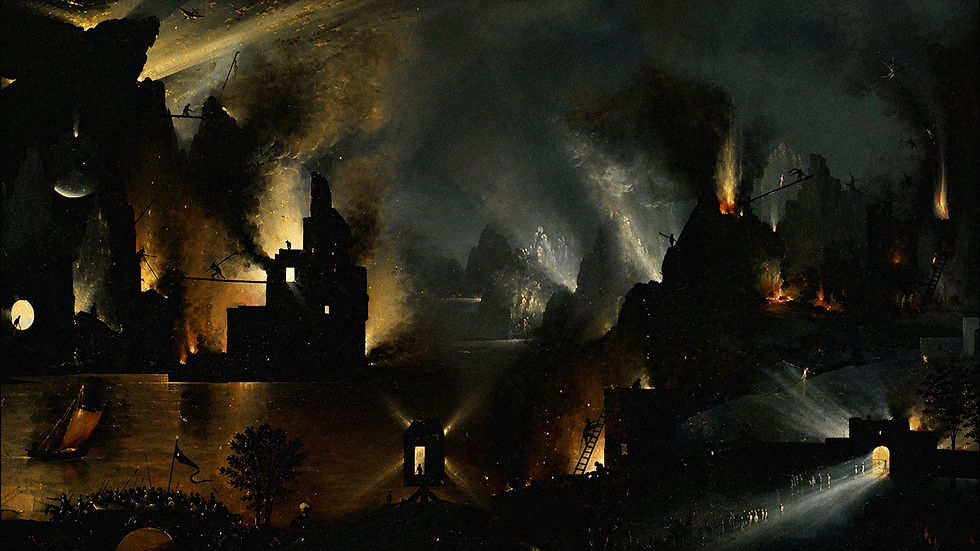
Synopsis: HyperBosch: The Garden Reanimeted is an experimental AI film inspired by Hieronymus Bosch’s iconic painting The Garden of Earthly Delights. Using artificial intelligence, the painting was first digitally cleaned from craquelure and then animated into a living, darkly poetic universe of desire, symbolism, grotesque creatures, paradise, sin, and infernal chaos.
_________________________________________________________________________________________
Your experimental film tells a compelling story that combines art, symbolism, poetry and artificial intelligence. How did this original idea come about?
The idea for HyperBosch: The Garden Reanimeted grew out of my long-standing relationship with painting, symbolism and the darker visual images of European culture. The fundamental story is, of course, not mine. I did not invent it. It comes from the biblical and moral symbolism that Hieronymus Bosch, known in Spain as El Bosco, embedded in his famous triptych The Garden of Earthly Delights.
What I tried to do was translate this medieval visual narrative into a contemporary cinematic language. I did not want merely to “animate” Bosch’s work as an attractive visual effect. I wanted to create a filmic reinterpretation that would preserve its essential trajectory: birth, blossoming, temptation, sin, collapse and punishment. This cycle appears repeatedly in my work, for example in my earlier experimental film Oneyear Garden.
Bosch has fascinated me since childhood. When I began painting and studying the old masters, his images affected me differently from anything else. There was brutality, humour, moral precision, grotesque imagination and an almost cinematic use of detail. I carried his visual world in my subconscious for a very long time. I think the way Bosch depicts darkness, sin, corporeality and human weakness corresponds very closely with how I imagine darkness myself. So HyperBosch: The Garden Reanimeted was born from a need to reopen one of the essential works of European culture and give it a new rhythm, new movement and a new audiovisual space. One quiet night I realised that, thanks to contemporary artificial intelligence tools, I could now do something that only a few years ago would have been practically impossible for a single author. I could reanimate Bosch’s garden, enter its details and allow it to speak again through film.

What does this work mean to you, and why did you consider it important to realise it in this particular way? Your vision is very personal. What is your connection to painting, and how do you see the role of artificial intelligence in mainstream cinema in the coming years?
For me, HyperBosch: The Garden Reanimeted has personal, visual and moral significance. I am not a religious person in the traditional sense, but I do not see Bosch’s message as merely religious. I see it as a practical statement about human behaviour. It is an image of how easily human beings surrender to desire, pride, power, the body, excess, violence and indifference. In other words, to what tradition calls the seven deadly sins: pride, greed, lust, envy, gluttony, wrath and sloth.
In this sense, Bosch’s triptych remains completely relevant. We can read it religiously,
philosophically, ecologically or psychologically. What is closest to me is its practical dimension: how we behave towards ourselves, towards other people, towards the body, towards desire, towards the planet and towards the gifts that have been entrusted to us. Although I sometimes make fun of the Church, I take this message seriously. In a certain sense, it is an illustrated manual on how not to destroy one’s own life.
My connection to painting is natural. I come from image, drawing, composition, light, layered meaning and detail. For me, cinema is not only plot. It is visual dramaturgy. In the case of HyperBosch: The Garden Reanimeted, I worked with the image as a living landscape through which the camera moves in a similar way to how the viewer’s eye moves across a painting. Artificial intelligence was not a gimmick here, but a cinematic instrument that made it possible to translate painting into a time-based medium.
My view of AI in cinema is rather pragmatic. If a shot can be created faster, cheaper and sometimes even more precisely than through a traditional production process, filmmakers will use it. If one author does not do it, another will. Similar ruptures have happened before: photography changed painting, sound changed silent cinema, television changed theatre and film, and the internet changed distribution and audience attention. I do not think AI will kill classical cinema, just as television did not kill theatre. But it will fundamentally transform it.
Traditional cinema will continue to exist because it is connected to reality, to actors, to their bodies, voices, lives and media aura. AI cinema, however, will open space for authors who would never have access to large-scale production. It will enable new visual genres, new professions and a new cinematic language. Some professions will fade, others will emerge. Some stars will disappear, others will shine.
I also made HyperBosch: The Garden Reanimeted with a very simple motivation: I wanted to see it one day on a real screen, in front of an audience. I wanted to find out whether an experimental AI film rooted in classical painting could truly meet the viewer. That is why its festival presentation in Spain is important to me, as is my next appearance at the Love & Hope International Film Festival Barcelona, where my work will once again meet an international audience.


Could you mention some of the difficulties you encountered while creating the film?
There were many difficulties. The source material itself is extremely demanding. Bosch’s The Garden of Earthly Delights contains motifs of nudity, sexuality, violence, bizarre bodily transformations, torture, grotesque brutality and religious symbolism. These are precisely the areas where today’s generative systems often collide with safety restrictions, content filters and interpretive limitations. There was a very thin line. On one side, I needed to preserve Bosch’s rawness, corporeality and moral brutality. On the other, I did not want to fall into self-serving shock, pornography or cheap violence.
For me, it was essential that HyperBosch: The Garden Reanimeted remained art, not a catalogue of forbidden images. How exactly I navigated some of those technical and content-related limits is something I will keep to myself for now. The second essential challenge was working with the painting itself. The film also relies on digital access to the details of Bosch’s garden. The work of Q42 - Micrio, who digitised the painting in high resolution and made it possible to enter its individual layers, scenes and details, played a major role. I was then able to treat those fragments as cinematic material: restoring them, cleaning them, expanding them, reconstructing them and eventually animating them.
Another layer was the use of AI artefacts. In my films, I sometimes leave them in deliberately. Not because I am too lazy to remove them, but because they can create a specific unease. The viewer often subconsciously feels that “something is wrong,” even if they cannot precisely name it. I consider this uncanny effect a legitimate part of contemporary AI film language. In HyperBosch: The Garden Reanimeted, the artefact therefore does not always function as an error, but sometimes as an expressive device. At the same time, I do not try to hide the fact that the film was created using AI. On the contrary. I see it as part of its authenticity. Today everyone is chasing image perfection, but I am interested in the moment when the medium still reveals its technological nature. Perhaps one day AI images will be perfectly smooth. But I am interested in this transitional phase, when a new cinematic language is still being born.
We would like to know more about how and why you chose this interesting approach. If you had to name three key concepts that could help everyone understand this film and notice details that may escape the ordinary eye, what would they be?
I would choose three concepts: sin, reanimation and transformation.
The first concept is sin. Not only in a religious sense, but as a fundamental dramatic force. Bosch’s garden is a vast visual encyclopaedia of human weakness. In HyperBosch: The Garden Reanimeted, I try to show that the seven deadly sins are not a dead medieval concept. Pride, greed, lust, envy, gluttony, wrath and sloth are still deeply contemporary. They simply wear different costumes, use different technologies and inhabit different settings today.
The second concept is reanimation. This is not animation in the conventional sense of making a picture move. It is the revival of an existing cultural organism. That is also why the film is called HyperBosch: The Garden Reanimeted. I wanted to create the impression that Bosch’s image was never truly static; it was merely waiting for a medium that would allow it to breathe, move, sound and exist in time.
The third concept is transformation. Everything in the film transforms: bodies, landscape, architecture, meaning and tempo. At first, the film works with softness, birth and almost meditative movement. Gradually, however, the image becomes denser, the rhythm accelerates and the world descends into destruction. This transformation corresponds to the structure of the triptych itself: paradise, temptation, hell.
In terms of detail, it is important to understand that no scene is merely decorative. Every creature, every act, every gesture and every deformation carries meaning. Bosch was a master of visual composition, and I tried to translate that ability into the temporal composition of film.

To understand the value of your work, we would like to know more about the mind behind this project. How would you define your personal experience with film as a director? Could you tell us about an experience or moment that marked you, or a challenge you faced?
When I immerse myself in creation, it becomes almost impossible to stop. Filmmaking is a very powerful form of self-realisation for me. At one moment, image, music, editing, sound, technology, script, intuition, improvisation and visual experience all come together. At that point, I feel that I am using everything I have ever learned.
I do not always work with a completely fixed script. Often I start from a visual, musical or symbolic axis, and during the process other ideas emerge. I would describe this as a method of introspection and controlled improvisation. In AI filmmaking, this is very natural, because shots can be generated quickly, but they never turn out exactly as one imagined. Sometimes that is a problem. At other times it is a gift.
This uncertainty is precisely what interests me about AI cinema. Traditional production often requires long planning, budgets, crews and logistics. In AI creation, some phases shrink from months to days or weeks. That does not mean it is easy. It means the creative process is more flexible. The author can respond more quickly to the image that is appearing in front of him. A strange dialogue emerges between the director and the tool.
With HyperBosch: The Garden Reanimeted, until the very end I did not know whether I would truly be able to animate all the key scenes. Some images were technically, conceptually and dramaturgically very difficult. In the end, however, there was not a single essential shot that I failed to bring into motion. That confirmed to me that my method is based precisely on the ability to improvise and find a path even when the medium resists.
This experience is also connected to my broader body of work. Whether it is Oneyear Garden, the music films Secrets of Kandahar – Parallax, Secrets of Kandahar – Cosmic Dance, or new projects such as Taste Channel, I am always interested in how far personal auteur cinema can be pushed without a traditional production apparatus.


Could you tell us more about the process of writing the script and how you chose the dynamics of the edit?
In HyperBosch: The Garden Reanimeted, the dynamics are not determined by the script alone. They are determined primarily by the image, the music and the inner dramaturgy of Bosch’s triptych. The film begins more slowly, almost contemplatively. Birth and blossoming need time. The viewer must enter the world, understand its visual logic and accept its rules. Then the dynamics begin to accumulate. The image thickens, bodies multiply, gestures accelerate, meanings are layered and the composition becomes more aggressive. The ending then shifts into sharp, brutal and rhythmically harder sequences of punishment, destruction and musical hell.
I wanted to preserve this symbolism in the sound as well. That is why I built the film on my own music from the project Secrets of Kandahar, specifically on a dark interpretation of the track Glitched Delights. At first, the music works with a more delicate atmosphere, but gradually it fractures into cutting darksynth structures. I wanted it to almost caress the viewer’s soul at the beginning and then tear it apart by the end.
The editing, therefore, is not just a technical ordering of shots. It is a rhythmic and psychological construction. It works with the contrast between tenderness and brutality, purity and decay, beauty and filth, birth and ruin. I believe this contrast lies at the core of Bosch’s world and at the core of HyperBosch: The Garden Reanimeted.
What are your expectations for the film? And how are you experiencing the phase of international competitions?
I sincerely hope that HyperBosch: The Garden Reanimeted will speak to the Spanish audience in particular. In Spain, Bosch — or El Bosco — holds a special position. The Garden of Earthly Delights is associated with the Museo del Prado in Madrid, and I feel a certain symbolic power in the fact that my cinematic reinterpretation of this work is reaching Spain.
I do not expect every viewer to read the film in the same way. That would not even be right. But I do hope that the audience will sense both respect for the original and the courage to work with it through a contemporary language. HyperBosch: The Garden Reanimeted is not a museum illustration. It is an auteur cinematic dialogue with a master who, centuries ago, created images so modern that contemporary technology is only now beginning to touch them.
I experience the festival phase very intensely. It is a strange mixture of nervousness, joy and uncertainty. A little like a first date. You never know how the audience will react. Especially with an experimental AI film that works with such a powerful visual source.
Beyond the Madrid presentation, my participation in the Love & Hope International Film Festival Barcelona is also very important to me. Barcelona has already played a significant role in my work thanks to the film Secrets of Kandahar – Parallax, which was also selected for the Love & Hope International Film Festival Barcelona. Returning to the Love & Hope International Film Festival Barcelona therefore feels like confirmation that my auteur AI work is beginning to establish an international continuity.
At the same time, I organise my own festival Playlist International Film Festival Hradec Králové / PiFF HK, which focuses on AI filmmaking. Because of that, I now perceive festivals from both sides: as an author sending a film into the world, and as a curator and organiser thinking about how to present AI cinema to audiences in a meaningful, dignified and dramaturgically precise way.
Could you tell us something about your next project?
I feel as if my creativity is on steroids right now. Perhaps I am going through the most productive period of my life. I am currently working on several projects that move between sci-fi, experimental film, music video, grotesque comedy, fairy tale and AI visual art.
One line of work is, of course, the world of Secrets of Kandahar, my AI new-wave synthpop / synthwave band, which is closely connected to my filmmaking. Films such as Secrets of Kandahar – Parallax, Secrets of Kandahar – Cosmic Dance and Secrets of Kandahar – Saucers, Secrets of Kandahar — Dreams (the newest one) are not merely music videos for me. They are chapters of a larger audiovisual universe.
Alongside that, I am developing GUST — Taste Channel, a sci-fi gastro comedy. GUST is part of scifi trilogy with Liturgy of Emergence and Prayer of Hyperfantasy, the latter of which was, in a way, my personal manifesto and a predecessor to HyperBosch. It was also the first project in which I reanimated my own paintings. The newest one project is The Perfect Execution, a scifi tragicomedy too on which I am collaborating with screenwriter David R. Schleicher. Its tone is completely different from HyperBosch: The Garden Reanimeted, but I am still interested in the same things: the absurdity of human beings, technology, the body, taste, civilisation and the future.
I am also trying to complete the animated fairy tale Bubola and the Cosmic Journey, which is close in spirit to The Little Prince. At the same time, I continue working on Playlist International Film Festival Hradec Králové / PiFF HK, because I want to create a space for authors who approach AI filmmaking seriously — not merely as an effect, but as an emerging artistic language.
I have sacrificed and risked a lot because of AI creation. I left my job, invested my own resources, time and energy. It required a great deal of courage. But HyperBosch: The Garden Reanimeted is proof to me that it was worth it. It is a film about sin, but for me personally it is also about overcoming one’s own humanity. Perhaps it is through creation that we become most aware of how sinful, fragile and fascinating we truly are. I would also like to thank my wife, who gives me the time, space and trust I need to fully realise myself through my work. Her support is essential to everything I do. Without her patience, understanding and belief in my creative path, many of these projects
would simply not be possible.
Check out these featured projects!
Know more about his amazing works!
Website: https://d3arts.cz/
FilmFreeway: https://filmfreeway.com/PetrChroustovsky
Vimeo: https://vimeo.com/d3arts
LinkedIn: https://www.linkedin.com/company/3061040
Patreon / d3arts.cz: https://www.patreon.com/c/d3artscz
Playlist International Film Festival / PiFF HK: https://play-list.cz/
Follow Him!
Facebook: https://www.facebook.com/d3arts.cz
Instagram: https://www.instagram.com/d3arts.cz/
YouTube: https://www.youtube.com/@d3artscz
--
Thank you for giving us the opportunity to speak with you!
We will be attentive to your next jobs!
MADFA® I Press Team
Madrid Film Awards®


Comments