
Exclusive Interview for "The Man Back From Europe" With Haifeng Niu


Haifeng Niu (Kevin), an independent film director from Mainland China.
As a little-known director, I persist in creating my own low-budget films while taking on multiple roles such as: director, screenwriter, producer, supervisor, planner, art designer, location scout, editor, voice actor, composer, costume designer, prop master, investor, etc.
"I aim to present my reflections, emotions, sensations, perceptions, and insights on my life through the medium of film, which I deeply love, and to share them and make full communication with all film and visual arts enthusiasts around the world."

Film synopsis: Jiang Haijun, a Chinese filmmaker who went to Europe to study after high school and settled in Germany for 20 years without ever making a name for himself, has achieved little success with his own films while grappling with the clash and fusion of Eastern and Western cultures. At the same time, as a film instructor, his own student won a major award at a renowned European film festival, leaving him feeling deeply embarrassed. To avoid the potential humiliation of facing his students, Jiang hastily decides on a whim to return to his homeland for a week after 20 years away. He hopes to reconnect with old high school classmates and friends, reliving the youthful camaraderie of the past, while seeking to restore his self-esteem and salvage his pride in his hometown. However, he finds that his homeland has transformed dramatically, his city has changed beyond recognition, and most of his former classmates do not take him—this “director from Europe”—seriously.
He also hopes to reunite with the girl he secretly admired in high school, but his wishful thinking leads only to a series of unexpected mishaps and nerve-wracking misunderstandings. In the end, Jiang comes to realize that perhaps the best way to cherish his first love is to keep her hidden in the purest corner of his heart, never to disturb her again. Returning to Europe, he may no longer feel embarrassed by his student’s success. But if he lets go of all lingering attachments, can he peacefully reintegrate into Western culture? Or does he still harbor an unyielding, deep-rooted connection to his homeland?
_________________________________________________________________________________________
In order to undertand the value of your piece, we would like to know more about the mind behind the process. How would you define your personal experience with cinema as a director? Could you tell us an experience or moment that change or challenge you?
Well, as we talked about the connection between a director’s personal life experience and his cinematic work, actually I believe it can be understood as a deep projection of life experiences. A director’s personal history, ideological views, and artistic sensibilities form the bedrock of his film style—especially in independent film. The different eras, social classes, nationalities, and cultural environments we inhabit all profoundly influence the themes and aesthetics of our works.
For example, Ang Lee’s early “Father Trilogy” projects his own repressed emotions and
memories, serving as direct creative inspiration. Turkish director Şeyhmus Altun directly
incorporates his childhood experience of forced displacement into his films. Independent film, in particular, usually means fewer commercial constraints and greater creative freedom, allowing the director’s personal imprint to be translated more directly into the flesh and blood of the work. For instance, Wayne Wang’s early films focus on the struggles of Chinese immigrants, a world he knew intimately.
In sum, I think a film director’s personal experience is the “source code” of his creation—especially in independent film. The director internalizes life experiences and then externalizes them through the art of light and shadow, elevating the work beyond
mere entertainment into a unique expression that carries a strong personal signature and can forge a deep spiritual connection with the audience.
As for my own experience, it’s sure that the creative origins of this film are, to some
extent, tied to my own life experience. For example, the sole protagonist shares with me
the fact that we are both film directors in reality. In other words, I placed some of my own personal reflections, perceptions, and feelings onto a character who is also a director, in order to express and present them. Why not choose another profession? Perhaps because I already have some independent thoughts and understanding of the role of a director; other professions might not offer me such direct experience or insight.

Furthermore, the film was shot in my hometown—a city that was once a German colony
over a hundred years ago. Even today, the old town retains many cultural relics from that colonial era, such as German‑ and European‑style architecture, streets, and even the city‑wide underground drainage system built by the Germans over a century ago and still in use. There is also the first beer company in China, founded by Germans, which remains one of the country’s largest breweries. What we need to consider is that the people of this city do not harbor much resentment toward that colonial history, nor toward Germany or Germans.
Such a non‑habitual cultural background and imprint have been embedded in the minds and thinking patterns of my generation and several generations before us since childhood. So when, years later, I wanted to create a film related to my hometown’s culture, all these decades‑old thoughts and feelings burst forth and struck me all at once, becoming a very unique source of inspiration and a driving force for creative challenge in my film.
However, beyond this, the main content of the film and the protagonist’s experiences are not directly related to my own personal life. Of course, his experiences, circumstances, state of mind, and confusion do share some slight similarities with the experiences of friends I have known over the years—for instance, many of my schoolmates who went abroad to study, whose stories have given me some creative inspiration.

Your film has a solid and ingenious story, combining suspense, action, love, and very distinct characters. How did the idea come about?
Yes,as you know, for years I have wanted to make a film about my hometown. As I
mentioned before, my hometown has a unique history and a culture of fusion. So many
imprints of modern history have been deeply etched into my growth from childhood to
adulthood. Today, as China continues to develop, my hometown has also undergone
great changes. If we still look at today’s urban and humanistic transformations through the lens of the past, then, to quote a line from the film, “it may indeed take some time to
readjust.” People who have lived here all along may not feel a sudden strangeness, but
from the perspective of someone who left home many years ago and happens to return
from overseas, one can more keenly feel the passage of time and the shift of civilization—along with a certain dimension of loss. This strangeness and loss manifest in all aspects of a person’s character, experiences, and even the persistence of love, and
collectively fermented into the creative inspiration for this work.
Could you tell us about any difficulties you encountered during filming? And what was the editing process like, and how was the soundtrack created?
Because it´s clear that it was crafted with great care. Ah, I’m actually afraid to answer such a question, because it brings back all the difficulties we encountered during the creative process. As you know, as an independent filmmaker, I have always insisted on making low‑budget films on my own, and, yes, I’m forced to wear many hats. I am not only the director, writer, and producer, but also the supervisor, planner, production designer, location scout, editor, dubbing artist, composer, costume designer, prop master, investor—and sometimes I even have to temporarily double as a grip or driver for the crew. At such times, you realise that no matter how well you think you’ve prepared before the shoot, you will always encounter all kinds of unexpected problems on set: set construction, art direction, props, actors sometimes unable to get into character, last‑minute changes of locations, as well as sudden issues with liaison, transportation, accommodation—you simply cannot foresee everything.

So, as you know that, this film was shot in my hometown, a very beautiful seaside city
with a European artistic atmosphere. One of the characteristics of a seaside city is fog—that kind of sea fog that fills the entire visual field. I had worried about rain affecting our outdoor scenes shooting, but instead of rain, we encountered three days of heavy fog, making shooting completely impossible. This affected our pre‑arranged locations, hotels, transportation, and actor schedules. Such situations always happen. You might ask how I solved them in the end. I can only say: there is no other way but patience. Of course, I had to be patient—because I would never give up.
As for the editing process, in my previous work I tried hiring a professional editor, but I found that I ended up spending a lot of time explaining every detail of my thoughts and the visual effect I wanted, and I couldn’t be sure the editor would fully grasp my vision.
I also had to stay by the editing console the whole time. So this time I didn’t hesitate and
decided to handle the entire post‑production process by myself, including editing.
Naturally, this came with its own set of problems and troubles, especially in sound editing. For example, when you place the dialogue recorded by the boom microphone onto the timeline, you often painfully hear all kinds of ambient noise and background sounds mixed in with the dialogue voices. You have to patiently re‑process those audio clips bit by bit, and sometimes even ask the actors to come back for ADR to match the final locked picture. Sound processing indeed consumed a great deal of my time and energy.
Regarding the film soundtrack, most of it consists of music I selected myself, which I felt best suited the film’s atmosphere—I listened to hundreds of tracks. In addition, I specially invited a professional composer based in the U.S., a graduate of UCLA, to create an original piece of music for this film. After learning about the film’s theme, she was very enthusiastic and offered to compose an original score for free. I gave her specific requirements for the music’s mood, theme, and atmosphere, hoping that the main melody would be played by the cello, accompanied by piano, violin, harp, etc. After nearly two months of frequent discussions and revisions, I was very satisfied with her final version, and we placed that original composition as the Ending Theme. I would like to take this opportunity to express my gratitude to the composer.
Yes you noticed that many details in the film were carefully crafted—thank you. In any
case, every effort yields a reward; there is no shortcut.
We believe that the story, beyond the entertainment, contains a profound message. We could say that its structure resonates with the conflicts many people face today regarding society, changes and the search for an authentic version of oneself. What can you tell us about it, the characters and how has your team´s synergy influenced the project´s outcome?
The protagonist of this film is a Chinese director who went to Europe to study after high
school and settled in Germany for 20 years, yet never made a name for himself.
Horizontally, he has long been facing the clash and forced fusion of Eastern and Western cultures—as he confesses to his old classmates, “I’ve never really been able to get used
to Western food; our Chinese food is still the best.” Vertically, along the timeline, he
confronts the immense changes that two decades of social transformation have brought
to his motherland and his hometown. The strangeness he feels upon his accidental return and the challenge of reintegrating instantly plunge him into even greater confusion—he does not know how to reconcile or merge the two geographic differences and two temporal gaps he inhabits. The protagonist, who has been searching for himself and hoping to prove his own worth, sinks deeper into anxiety, bewilderment, and loss. His habitual mindset and principles, when confronted with the forced integration along both axes, inevitably cause a series of mishaps and nerve‑wracking misunderstandings—thus generating a chain of dramatic conflicts. This is the basic structure of the work. As you pointed out, this may well be the kind of structural conflict that many people today face in society, amidst change, and in their search for an authentic self.
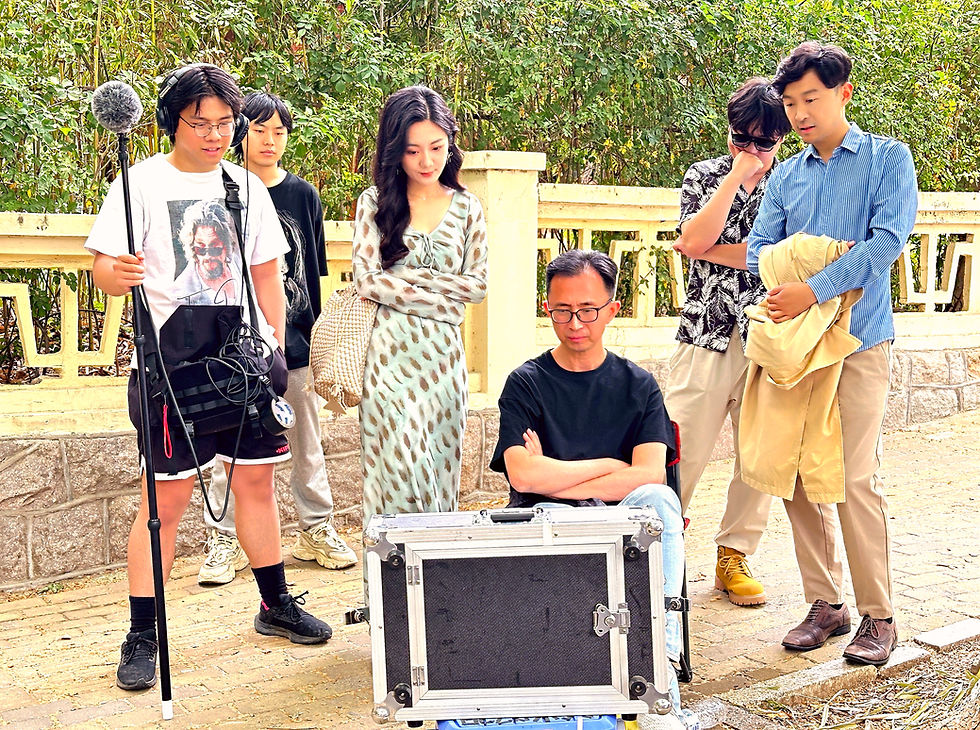
Ah, as for teamwork—I have only one word: fantastic. I am truly grateful to my team for
their dedication, synergy, and efficiency throughout the entire project. They were the most important factor in bringing this work to completion. I hope we can have the opportunity to collaborate again in the future.
If you had to name three key concepts to help everyone understand and enjoy more this film, what would they be? And what was the most valuable thing you learned making this movie?
Confusion and loss, mishaps and misunderstandings, self‑reconciliation.
I won’t elaborate on why these three terms, to avoid spoilers. But I think they are key
handles for understanding the film—they relate to the painful process of the collision and fusion of Eastern and Western cultures, the perplexity and disorientation brought about by historical changes experienced over time, and ultimately the attempted extension of the concept of self‑reconciliation and redemption.
Fellini once said that "all art is autobiographical", what was the most valuable thing you learned in your career? And what would you recommend to those who are taking their first steps in the cinema industry?
This question has already been touched upon in the first one. Regarding the famous
quote by the great Italian director Fellini—if we apply it specifically to a film director
creating a film—I understand that it doesn’t necessarily mean the story is directly
autobiographical in terms of the director’s actual events. However, it undoubtedly reflects a projection of the director’s inner world. The way a film is presented and the details it portrays are not always deliberately designed; they can be seen as the director’s subconscious “signature.” Thus, filmmaking, like other artistic creation, is not simply “writing one’s heart with one’s hand”—that would be just a diary. When an artist digs into his “private psychic world” with extreme honesty, he actually touches the “collective unconscious” of humanity, because the deepest commonality among human beings lies precisely in the most unique individual experiences.
Specifically, from my own years of making independent or auteur films, I cannot claim to
have any particularly valuable experience to share—everyone’s journey is different. But if there is one most valuable thing I have learned, it is honest thinking and sincere
expression. Nothing is more important or valuable than that. One’s own experiences,
cognition, and reflections are often not in line with the mainstream—that is normal. What matters is whether you have the courage to persist in your independent thinking and to express it honestly. There is no other way.
As for newcomers to the film industry, I don’t think I have any advice to offer. Every
creator’s work should be uniquely their own; I myself am still in constant reflection and
continuous creation. If there is one thing I would like to say, it is: stay true to yourself. Do
not cater to anyone else. Create works that belong only to you.

Did the film meet your expectations? Share your thoughts on the production, the competition area, their reach, and how you achieved them!
I can’t remember who said it, but film is always an art of regret—ha! In fact, I ‘m sure that
any artistic creation probably contains elements of final regret. I don’t think that is the
most important thing. What matters is whether you can do your best to express your true thoughts. I do not set excessively high or unrealistic benchmarks for my own works. So I believe this film essentially presents the original intention I had at the start. Of course, there are inevitably some regrets, due to various objective factors, and my own creative skills still need continuous improvement—I cannot rush that. In any case, I will keep a healthy creative mindset. As for the production process, the challenges encountered and how they were resolved—I have already discussed some of them earlier, so I won’t repeat them here.
Can you tell us something about your next job?
Yes, I am already preparing my next independent project. I can’t disclose specific details
for now, but I can say that it will continue to focus on the real‑life conditions of ordinary
people in today’s harsh and rapidly changing social environment. The script is almost
finished. I hope the creative process will be smoother this time than the last—haha!

Know more about his amazing works!
password: gvds
--
Thank you for giving us the opportunity to speak with you!
We will be attentive to your next jobs!
MADFA® I Press Team
Madrid Film Awards®


Comments